Ziyareta Siltan Êzîd: The Yazidi Temple in the Heart of Georgia
Ever since I first heard about Ziyareta Siltan Êzîd, the Yazidi temple in Tbilisi, Georgia, visiting this sacred place had been close to my heart.
For a long time, I imagined that I would travel to meaningful places like this with a partner. But I am still single, and I eventually realised that I did not want to wait for a prince on a white horse before beginning the journeys that mattered to me. It was time to make them happen on my own.
As an introverted person, I prefer to understand a place before entering an unfamiliar situation. I therefore tried to find as much information as possible about the Sultan Ezid Temple in Georgia, its customs and the appropriate behaviour for visitors.
Although the temple already has a well-designed website, I could not find all the practical information I needed. I especially wanted to know whether there was a contact person and which religious customs visitors were expected to follow.
When I finally felt prepared, I left my hotel in central Tbilisi and made my way to the temple. My heart was already beating faster before I arrived.
My First View of the Yazidi Temple in Tbilisi
Seeing the Yazidi temple in Georgia for the first time was emotional. Until then, I had known it only through photographs and videos on social media.
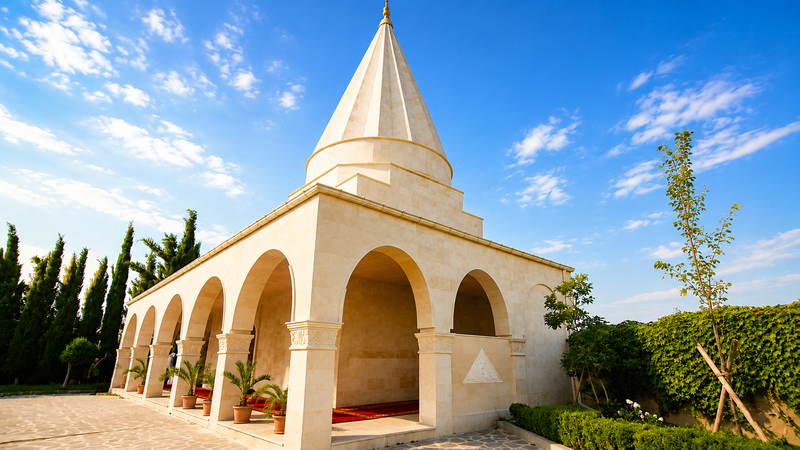
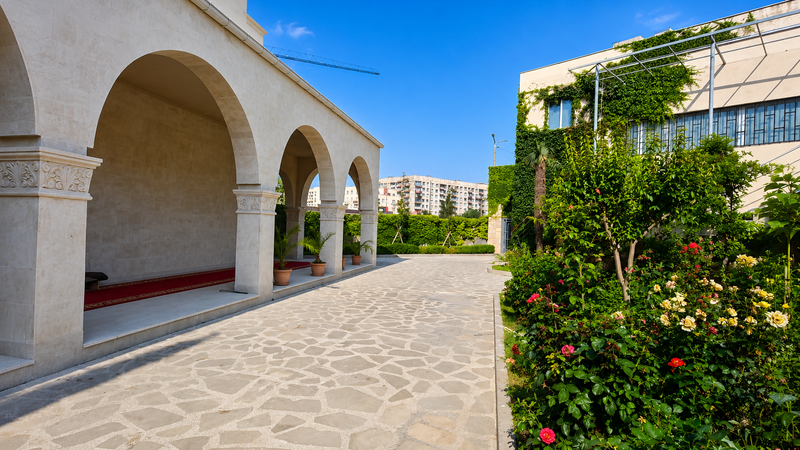
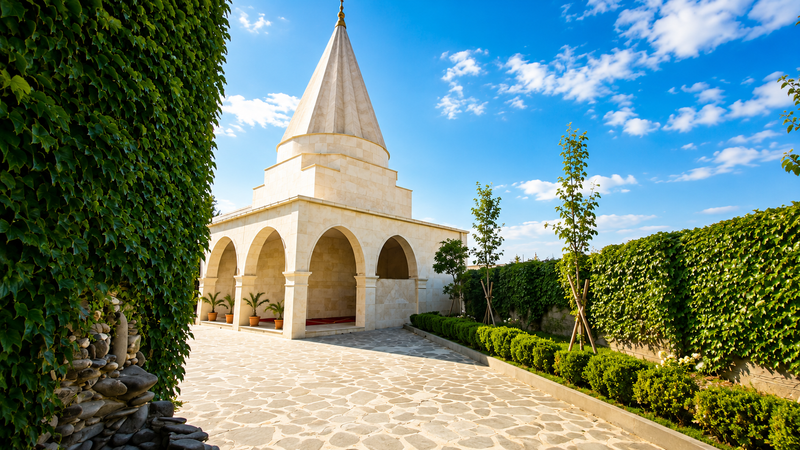
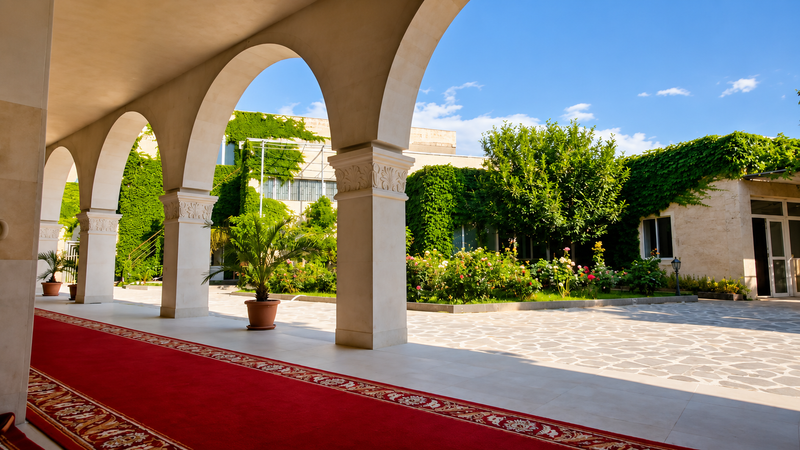
After entering the grounds, I first saw the garden, followed by the architecture of the main building and the sign displaying the temple’s name. I walked through the gate, caught my first glimpse of the Qub , and then returned to the entrance of the main building.
At that moment, I appeared to be completely alone.
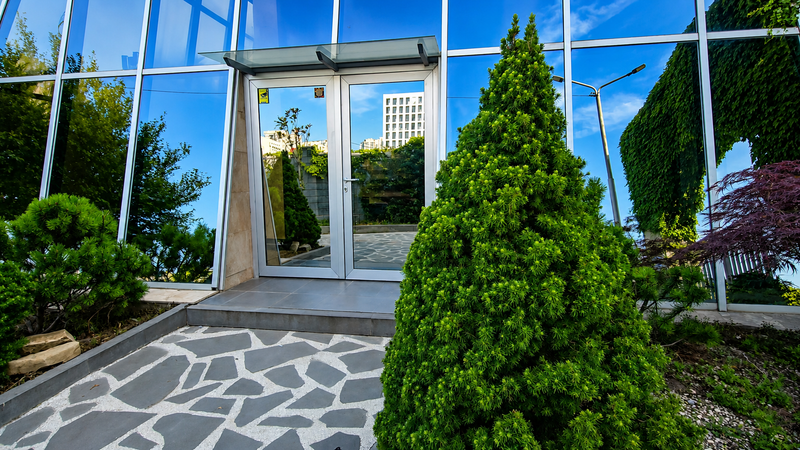
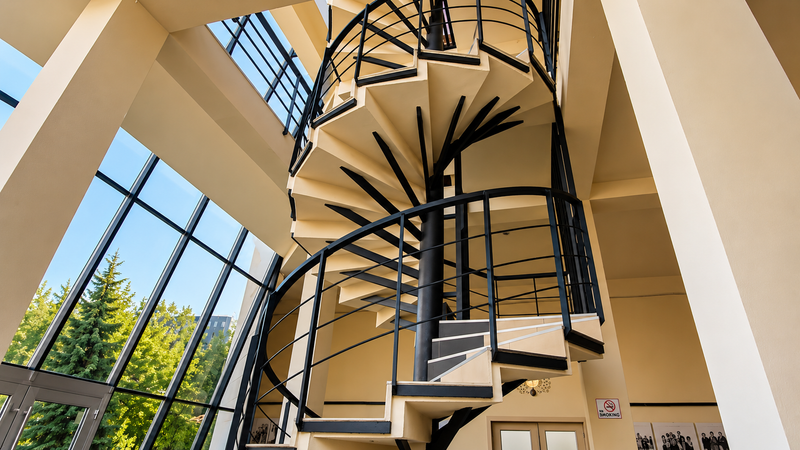
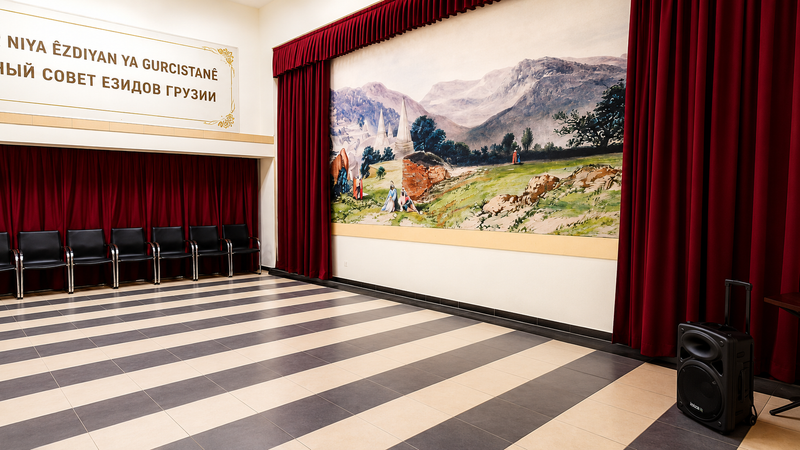
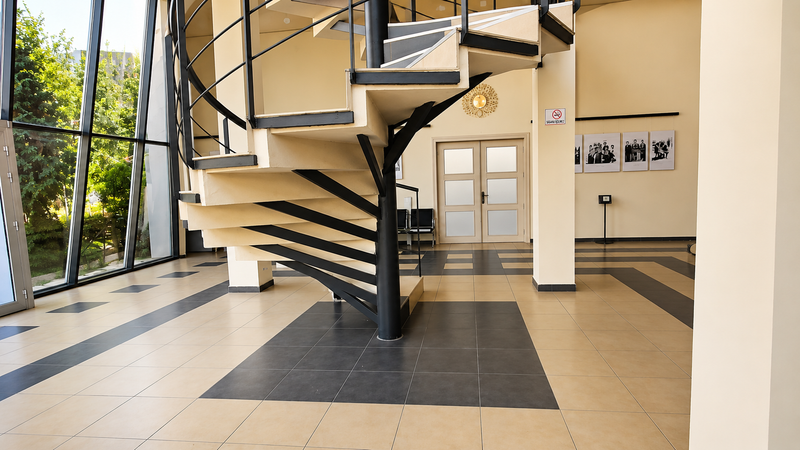
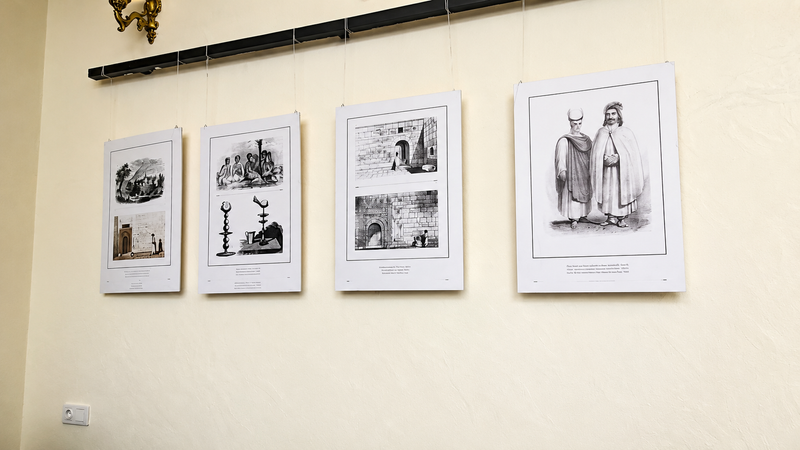
Behind the glass entrance door is a spiral staircase leading to the upper floor. Straight ahead is a large room used for seminars, conferences, press events and community gatherings. The walls display paintings of Yazidi historical figures, leaders and heroes, as well as photographs documenting Yazidi history.
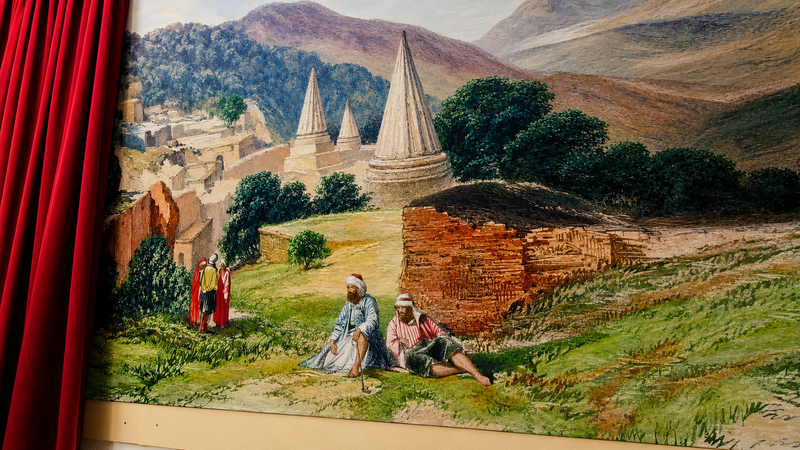
Another section of the building was still under development during my visit. I was told that it was intended to become a museum, although the room itself remained hidden behind a large, heavy curtain.
Guest bathrooms are located on the ground floor. Upstairs, there are offices and rooms used by students.
What many visitors may not know is that the temple complex is also connected to the teaching of Yazidi theology and history. I was told that this educational programme was the first of its kind. When I arrived, the students had just finished their lessons. Later that day, I would have the opportunity to meet them.
Meeting the Micêwr of Ziyareta Siltan Êzîd

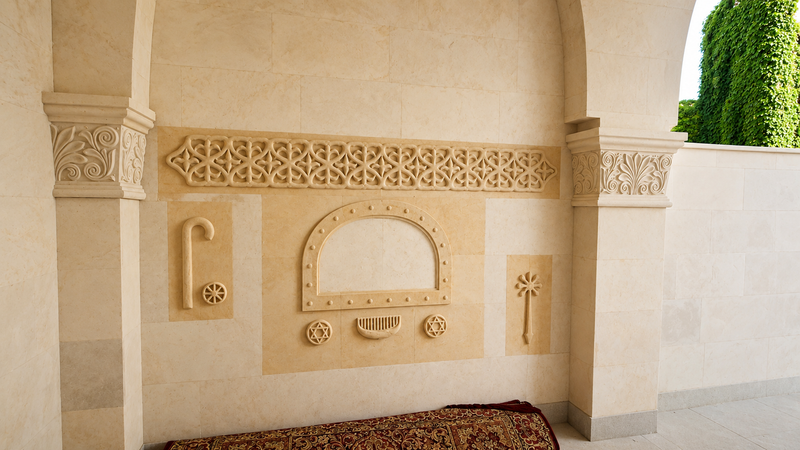
Şêx Nuri standing beside the symbolic stone wall outside the Quba Siltan Êzîd in Tbilisi, Georgia, on 11 July 2026.
I returned to the Qub and met two people outside. One of them was Rustem, who volunteered at the temple.
Before entering the sacred space, all visitors must remove their shoes. The floor of the Qub must not be touched by outdoor footwear.
Rustem welcomed me and called Şêx Nuri, the temple’s Micêwr , a religious role that may be described in English as a Yazidi priest or temple priest.
I was extremely nervous. Following tradition, I kissed Şêx Nuri’s hand and touched it to my forehead. I then tried, somewhat awkwardly, to explain that I hoped he would understand my dialect. I asked him to tell me what I needed to know so that I would not accidentally behave disrespectfully.
While we spoke, he gave me a white scarf with which to cover my hair.
I felt enormously relieved. The previous day, I had searched all over central Tbilisi for a suitable scarf but had been unable to find one. I knew that I needed to cover my hair inside the Qub, so I had postponed my visit rather than arrive unprepared.
Fortunately, head coverings and garments for covering the legs are available at the temple.
Dress Code and Rules for Entering the Qub
Short or revealing clothing is not appropriate inside the Yazidi temple.
During my visit, a family arrived with two children. One of the boys was wearing shorts and was also asked to cover his legs. This made it clear that the dress code does not apply only to women.
Both male and female visitors should wear clothing that covers the body appropriately. Women and girls are expected to cover their hair, while shoulders, legs and cleavage should remain covered.
Shoes must be left outside before entering.
Yazidi visitors may also follow traditional gestures at the entrance, such as kissing the doorframe, touching it with the forehead and stepping over the threshold rather than directly onto it. Visitors who are unfamiliar with these practices should observe respectfully or ask the Micêwr for guidance instead of copying a ritual without understanding it.
Inside the Sacred Qub

Inside Quba Siltan Êzîd, the Yazidi temple in Tbilisi, Georgia
The atmosphere inside the Qub of Ziyareta Siltan Êzîd is peaceful and deeply spiritual.
Along the walls are designated spaces bearing the names of Yazidi holy figures. There are no portraits in these places. Their names alone identify the sacred figures being honoured.
Visitors will also see the colourful cloths associated with Yazidi prayer traditions. During prayer or while making a wish, a person may tie a knot into one of the cloths. The cloth may also be kissed as a gesture of reverence.
A large representation of Tayir Tawûs, the peacock symbol associated with Tawûs-î-Melek, is another central visual element inside the Qub.
Photography and filming may be permitted in certain areas, but permission should never be assumed. Even where photographs are allowed, the temple remains a place of worship, prayer, peace and reflection, not a tourist attraction or a backdrop for entertainment.
Visitors should speak quietly and keep their movements calm. Personally, I would recommend talking as little as possible. The silence allows you to experience the atmosphere of the sacred space more fully.
Telephone calls, loud conversations and music are inappropriate inside the Qub.
Receiving the Bazinbar

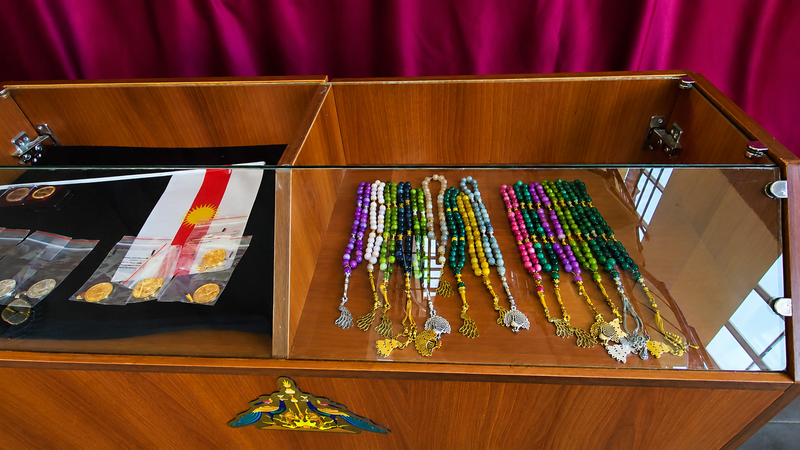
Bazinbar, the sacred red-and-white braided threads of the Yazidi faith, are prepared for visitors to receive a traditional blessing.
During a visit, Şêx Nuri may give guests a Bazinbar, a red-and-white thread tied around the wrist.
The Bazinbar is often associated with Yazidi identity and tradition, although similar red-and-white threads also exist among other peoples and communities in the Middle East and surrounding regions.
Within Yazidi tradition, the Bazinbar is connected to the arrival of spring. It is commonly distributed in April during Çarşema Serê Nîsanê, the Yazidi New Year.
Receiving it at the temple felt meaningful to me. It was not merely a souvenir but a symbol connected to faith, renewal and belonging.
A Conversation with Şêx Nuri
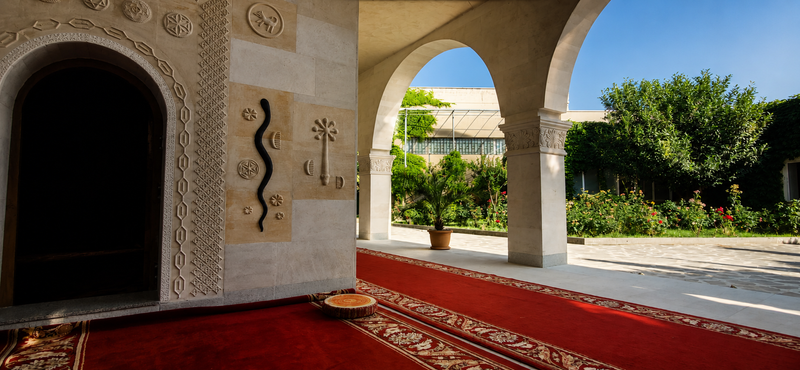
After visiting the Qub, I sat with Şêx Nuri in one of the outdoor guest areas. The temple has two similar seating spaces furnished with carpets and cushions. Shoes must also be removed before entering these areas.
There, I was able to ask him questions about the temple, his life and the Yazidi community in Georgia.
Şêx Nuri was born and raised in Georgia. His family originally came from the region that is now part of Turkey and, like many Yazidi families, had fled to the Caucasus during a period of persecution and violence.
I could understand his dialect, although I had to concentrate. Yazidis who grew up in different regions have lived under the influence of different languages, histories and neighbouring cultures.
For example, the Ezdiki spoken by some Yazidis from Türkiye contains vocabulary influenced by Turkish, Persian and Arabic. Yazidis from the Caucasus have experienced other linguistic and cultural influences.
These differences can be heard in everyday speech and may also appear in customs, traditions and social behaviour. They do not erase a shared Yazidi identity, but they show how migration and geography have shaped Yazidi communities in different ways.
Meeting the Students of Yazidi Theology
Şêx Nuri told me that a traditional evening prayer and lighting ceremony would take place later that day. He encouraged me to remain at the temple and participate.
Gradually, the students began to arrive.
I met a group of exceptionally polite, warm and hospitable young people, including three young women who were studying during that semester. For privacy reasons, I will not mention their names. But should any of them ever read this article, I want to say:
Thank you for allowing me to be your guest and for treating me with such kindness.
Their hospitality touched me deeply. They patiently answered my questions, explained traditions and helped me understand what was happening around me.
For someone who had arrived afraid of making mistakes, their openness made an enormous difference.
Meeting Pir Dima
Later, Pir Dima arrived with several visitors who were not Yazidi but were interested in learning about the temple.
I immediately became nervous.
I knew that I should greet him traditionally, but I was unsure when to approach without interrupting his conversation. One of the students finally encouraged me by saying, “Stand in front of him and greet him. Do not be afraid.”
So I did.
In that moment, I felt like someone learning to walk and worrying about falling. I had great respect for Pir Dima and did not know when or how I should speak to him.
With Şêx Nuri, conversation had felt easier. With Pir Dima, my sense of reverence was stronger, perhaps because I had read so much about his work over the years.
Pir Dima is not only a Pir within the Yazidi religious community. He has also worked for decades to preserve and teach Yazidi history, theology and cultural knowledge, particularly among younger generations.
I greatly admire this work.
Still, I found it difficult to speak freely because I was afraid of expressing myself incorrectly in Ezdiki. German is the language in which I communicate most confidently, whereas Ezdiki carries forms of religious and social etiquette that do not always have direct German equivalents.
One example is the expression “Xwedê ji te razî be”, a phrase of blessing and gratitude that cannot be translated into German without losing part of its cultural meaning.
When we were all sitting together, Pir Dima asked about my family’s place of origin. I explained where my relatives came from, and he immediately recognised the village. I was surprised and impressed by his detailed knowledge of Yazidi communities and their histories.
Participating in the Evening Ritual of Êvara Çira
After sharing dinner with the community, I was invited to take part in Êvara Çira (Evening of the Sacred Lights).
Pir Dima and Şêx Nuri stood at the entrance to the Qub. The students formed a line according to the religious and traditional order followed by the group.
The male students wore the traditional red-and-white Cemedanî headscarf, while Pir Dima and Şêx Nuri wore their distinctive religious head coverings. The female students wore white headscarves. I also wore a white headscarf to cover my hair as a sign of respect.
I was extremely nervous and did not want to make a mistake. A young Şêx woman standing in front of me quietly advised me to follow her movements.
That simple guidance helped me enormously.
Pir Dima and Şêx Nuri began reciting or singing a Qewl, a sacred Yazidi hymn, as they entered the Qub. The group walked around the interior. During a later round, sacred places associated with the holy figures were kissed, as were the colourful prayer cloths.
I did not record the ritual.
I had not asked for permission beforehand, and beginning to film during such a sacred moment would have felt disrespectful. Sometimes an experience should not be reduced to content. It should simply be lived.
For the students, the ceremony was familiar. For me, it was completely new and emotionally overwhelming.
During the ritual, I found a quiet moment to pray for my mother’s health.
An Evening of Qewls, Questions and Community

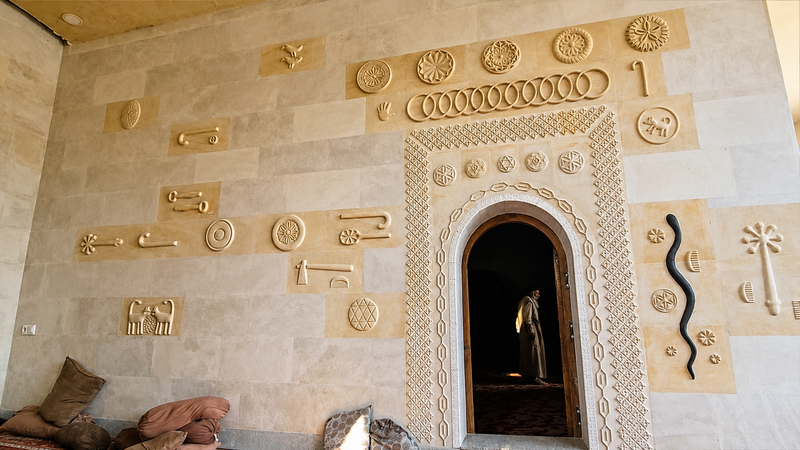
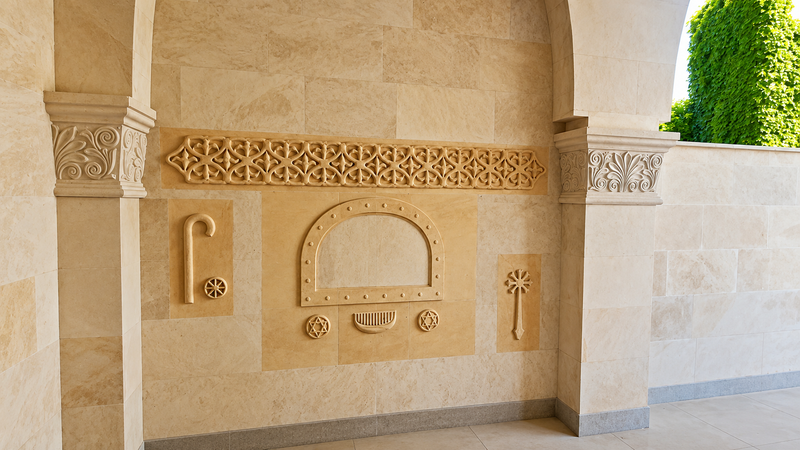
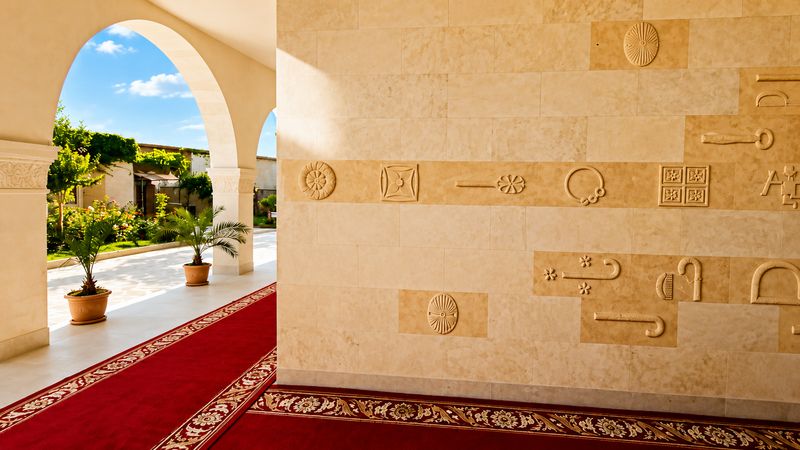
One of the two covered guest seating areas outside the Qub, within the temple complex, featuring traditional carpets, floor cushions, and Yazidi symbolic reliefs inspired by Lalish.
After the ceremony, we returned to the outdoor guest area. The students brought fruit and drinks and continued to treat me with remarkable hospitality.
I was told that the group often sits together in the evening to discuss questions, exchange knowledge and listen to further Qewls.
When Qewls are performed, the head should be covered. The male students also wore head coverings during the recitations.
I was deeply impressed by how much they had learned.
I do not know a single complete religious text by heart, yet some of these young students were able to recite long and complex pieces of Yazidi oral tradition.
One student performed “Mir Meh” and later sang “Xerîbo”. I was surprised to learn that he was only 21 years old. He had mastered knowledge and forms of recitation that are often associated with much older generations.
I had to concentrate carefully to understand the words and their meaning, but listening to him was one of the most memorable parts of my visit.
At around 11 p.m., we said goodbye because the students had lessons the following day.
Şêx Nuri had invited me to stay with his family, but I had already paid for a hotel room and left my belongings there. I promised that I would return the next day.
And I did.
Returning to Ziyareta Siltan Êzîd
On my second visit, I once again remained at the temple until the evening.
The students, Şêx Nuri and Pir Dima continued to welcome me warmly. By then, I barely wanted to leave.
I also met Şêx Nuri’s family, including his kind wife, who treated me with the warmth of a mother welcoming a daughter into her home.
Before leaving, we exchanged contact information and promised to meet again.
My time at Ziyareta Siltan Êzîd in Tbilisi became far more than an ordinary temple visit. It connected me with people, religious knowledge and traditions that I had previously known only from a distance.
A Place of Peace Open to Respectful Visitors
The Sultan Ezid Temple in Georgia is a place of stillness, prayer and community. Visitors of different religions and backgrounds may be welcomed, provided that they approach the temple and its people with genuine respect.
During my stay, I met non-Yazidi visitors who were curious about the religion and wanted to learn. Their presence showed that the temple can also serve as a place of dialogue.
At one point, a Kurdish visitor joined the gathering and referred to Yazidis as Kurds. The people present made it clear that they define their own identity and do not wish to have it imposed on them by outsiders.
For me, that moment was significant. It reminded me that visiting a sacred place also means listening to the people to whom it belongs and respecting how they describe their own religion, history and identity.