Quba Mêrê Dîwanê: Visiting the World's Largest Yazidi Temple in Armenia
After my unforgettable visit to Ziyareta Siltan Êzîd in Tbilisi, I honestly thought my journey was coming to an end.
My flight back to Germany was only a few days away, and originally, Georgia had been the final destination of my trip. But the more I thought about it, the more one question kept bothering me.
When would I ever get another chance to visit the world's largest Yazidi temple?
Armenia was only a few hours away.
If I flew home now, I would probably regret it for years.
So instead of booking my return flight, I booked a bus ticket to Yerevan .
Looking back now, it was one of the best decisions I made during my entire journey.
Unlike Georgia, where I often felt like tourists were seen as walking wallets, Armenia welcomed me with genuine kindness from the very beginning. People were incredibly helpful, prices were fair, and I immediately felt more relaxed.
Little did I know that my visit would begin with one of the biggest water fights I had ever seen.
Completely Soaked Before I Even Left
On the morning of my visit, I decided to get a haircut before travelling to the temple.
When I left the barber a short while later, I immediately noticed something strange.
Children were running through the streets carrying buckets.
People stood on balconies holding hoses.
Drivers slowed down their cars for absolutely no reason.
For a second, I wondered what on earth was happening.
Then someone emptied an entire bucket of water over me.
Within seconds, I was soaked from head to toe.
Welcome to Vardavar.
Every summer, Armenia celebrates one of its oldest traditions by throwing water at literally everyone they can find. Friends attack friends. Children attack adults. Strangers attack complete strangers. Nobody is safe.
At first, I had absolutely no idea what was going on.
Then I simply started laughing.
There was no point trying to stay dry anymore.
The only downside?
My phone got wet as well.
I didn't realise it yet, but this would cause me quite a headache later that day.
Armenian Hospitality at Its Best
Once I had finally escaped the city's water war, I opened my taxi app.
Nothing. Every driver cancelled. Again. And again.
The city centre was chaotic because of the festival, and nobody wanted to drive all the way to Aknalich.
I was already wondering whether I would have to postpone my visit when the receptionist at my hotel noticed my increasingly frustrated expression.
“Is everything okay?”
After I explained the situation, she immediately picked up the phone and called a local taxi driver herself.
Since I only had my credit card with me, she even paid the driver in cash before I reimbursed her.
I happily left her a generous tip.
It was such a small gesture, but one that perfectly summed up my experience in Armenia.
People genuinely wanted to help.
Finally...
About forty-five minutes later, the scenery slowly began to change.
Apartment blocks disappeared.
Busy roads turned into quiet country lanes.
The further we drove away from Yerevan, the emptier everything became.
Fields stretched across the landscape.
Small villages appeared every now and then.
Apart from a few cars, there was almost nobody around.
Then, in the distance, I suddenly spotted something white rising above the surrounding countryside.
Even from far away, there was absolutely no mistaking it.
Quba Mêrê Dîwanê.
The closer we got, the larger it became.
I had seen countless photographs online before my trip.
None of them prepared me for seeing it in person.
My First Impression
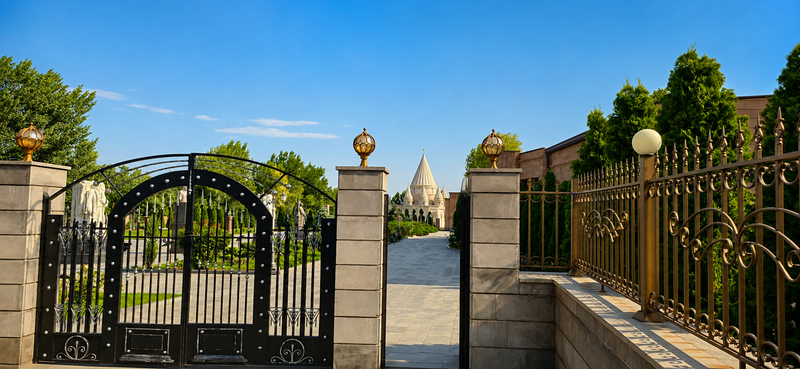
As soon as I stepped through the entrance gate, everything became quiet.
It almost felt as though I had left the outside world behind.
After the noise, crowds and water fights of Yerevan, the silence felt almost surreal.
The temple complex is beautifully maintained.
Stone pathways wind through colourful flower beds, neatly trimmed hedges and countless roses. Benches are scattered throughout the gardens, inviting visitors to sit down and simply enjoy the peaceful surroundings.
Unlike many famous religious sites around the world, there were no souvenir stalls.
No loud tour groups. No vendors trying to sell postcards.
Just peace.
I took my time walking through the grounds before even approaching the temple itself.
Several statues and memorials caught my attention along the way.
One of them immediately stopped me in my tracks.
It was Nadia Murad.
The Nobel Peace Prize laureate is portrayed almost like an angel, breaking free from shattered chains.
Standing there, looking at the statue, I couldn't help thinking about everything the Yazidi people have endured over the centuries.
Seeing her honoured in such a beautiful place was incredibly moving.
A little further on stands the mausoleum of Mirza Sloyan, the Yazidi philanthropist whose vision made this extraordinary complex possible.

Mirza Sloyan's Mausoleum with Quba Siltan Êzîd in the background.
Without his generosity and commitment, Quba Mêrê Dîwanê would simply not exist.
His dream was far greater than building another place of worship.
He wanted to create a spiritual home for Yazidis around the world: a place where future generations could preserve their religion, culture and identity.
His final resting place lies between the first shrine, Ziyareta Siltan Êzîd, completed in 2012, and the magnificent main temple that followed several years later. I found that incredibly fitting. It almost feels as though he is still watching over the place he helped create.
The World's Largest Yazidi Temple
Eventually, I reached the heart of the complex.
Standing directly in front of Quba Mêrê Dîwanê for the first time is difficult to describe.
No photograph had prepared me for its sheer size.
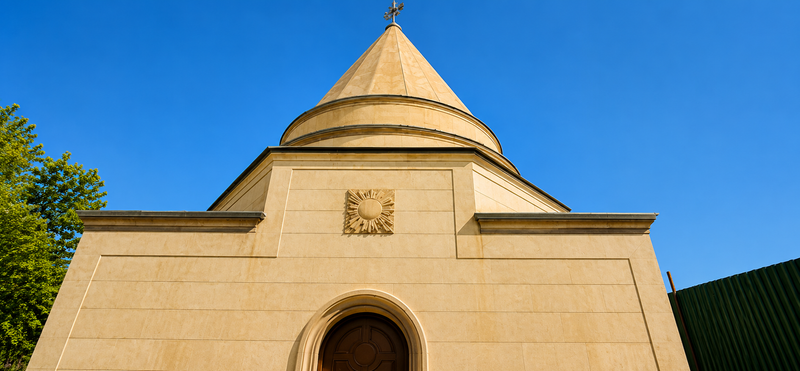
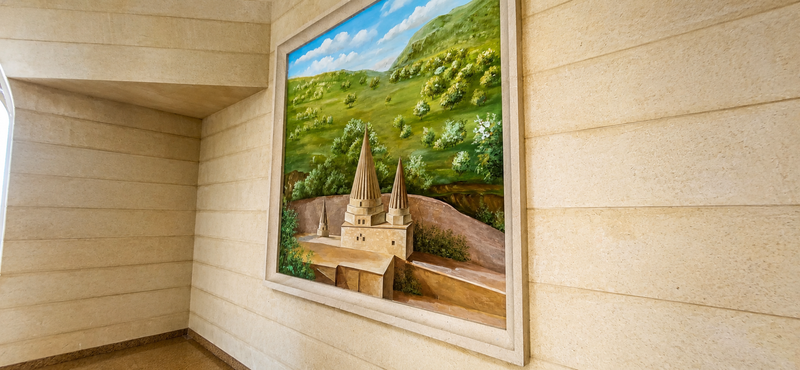
Rising 25 metres (82 feet) into the Armenian sky, the temple dominates the otherwise flat landscape surrounding Aknalich. Built from bright natural limestone, it immediately reminded me of Lalish, the holiest site of the Yazidi faith in northern Iraq. While clearly inspired by traditional Yazidi architecture, the temple has its own unique identity and an impressive scale that makes it unlike any other Yazidi place of worship in the world.
The building consists of a large central sanctuary surrounded by seven distinctive domes, each representing one of the Seven Holy Angels in Yazidi theology.
The temple itself is dedicated to Tawûs-î-Melek and the Seven Holy Beings (Heft Sirr), the divine beings entrusted by Xwedê, the Creator, with governing the world.
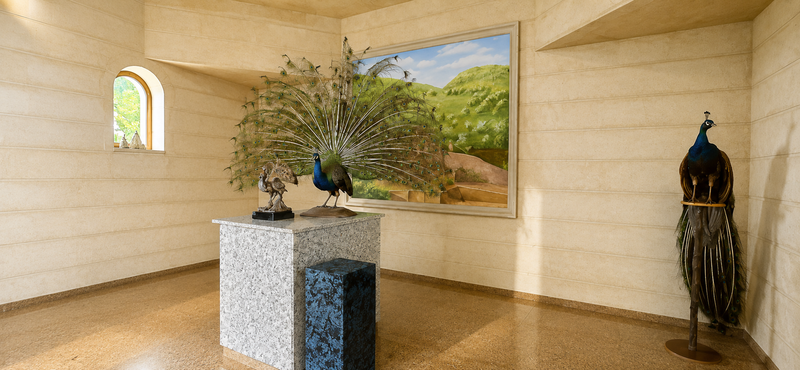
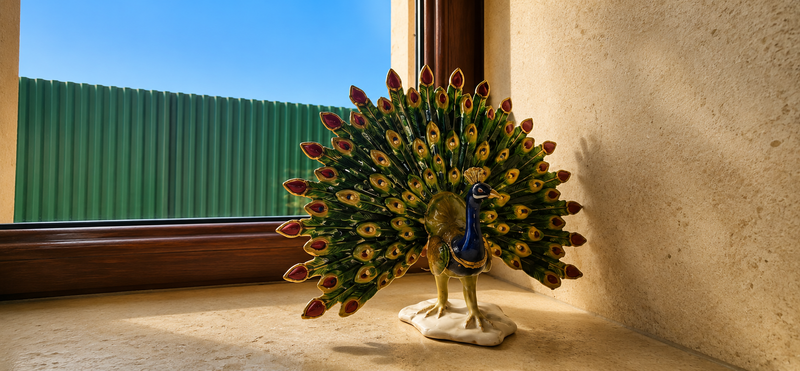
For those unfamiliar with the Yazidi faith, Tawûs-î-Melek (traditionally represented by a peacock and often referred to as the Peacock Angel) holds a unique and central place in Yazidi theology.
He is the most important figure of the Yazidi Holy Triad and stands immediately after Xwedê in the Yazidi Symbol of Faith. As the leader of the Seven Angels, Tawûs-î-Melek governs all major and minor divine beings and is regarded as the central figure of the Yazidi religion. In many ways, he represents the very heart of Yazidism itself. This gave the entire building an even deeper meaning.
This wasn't simply an impressive piece of architecture.
It represented the centre of a faith that has survived countless attempts to erase it.
I slowly walked around the temple, admiring the incredible craftsmanship.
Every stone seemed perfectly placed.
The elegant carvings, the golden ornaments crowning each spire and the symmetry of the entire building created an atmosphere that felt both majestic and peaceful at the same time.
For a while, I simply stood there.
No camera.
No phone.
Just taking it all in.
Entering the Qub
Eventually, it was time to step inside.
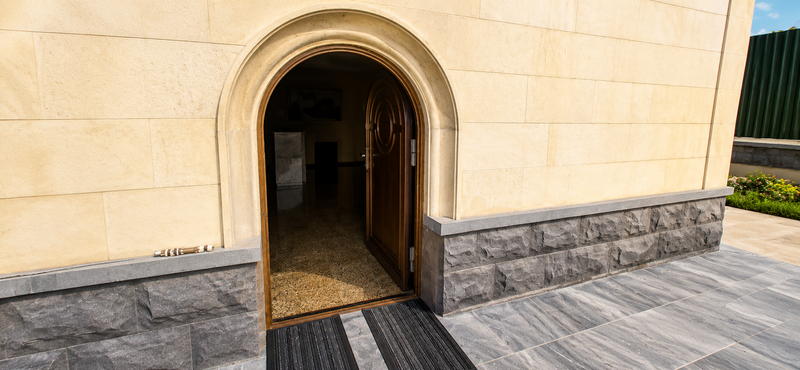
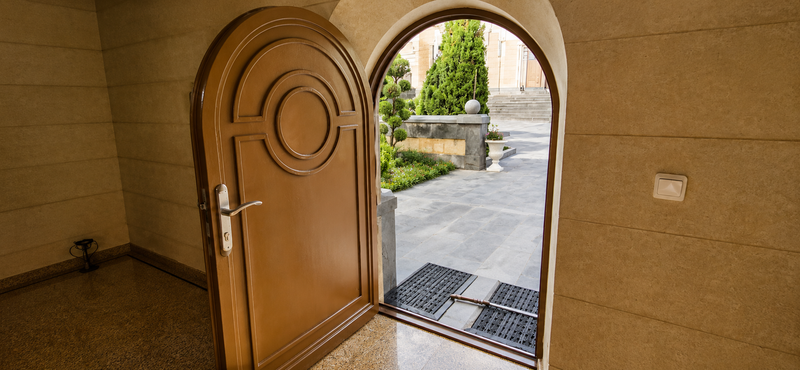
Before entering the Qub, I removed my shoes, as is customary in every Yazidi temple. I also made sure that my hair and shoulders were covered out of respect for the sacred space.
If you are planning to visit Quba Mêrê Dîwanê yourself, I highly recommend familiarising yourself with the basic etiquette beforehand. Unfortunately, I noticed that the temple's official website provides very little information for international visitors. Since many tourists may never have visited a Yazidi place of worship before, a simple guide explaining the dress code and temple customs would be incredibly helpful.
Inside the Qub, silence surrounded me almost instantly.
The bright stone walls reflected the sunlight entering through the windows, creating a warm and peaceful atmosphere.
Unlike many churches or cathedrals, there were no elaborate decorations competing for attention.
Everything felt simple.
Purposeful.
Peaceful.
It was exactly how I imagined a place of prayer should feel.
I quietly found a place to sit and spent a few minutes praying for my mother's health.
Before leaving, I placed a small donation inside the temple.
For me, it was a simple gesture of gratitude.
Being able to visit such an important place for my religion was something I did not take for granted.
As I stood up to leave, I noticed something that made me smile.
Directly above the entrance, a family of birds had built their nest.
The mother bird flew back and forth, feeding her chicks while visitors quietly entered and left beneath them.
It was such a small detail, yet somehow it perfectly matched the peaceful atmosphere of the temple.
Sometimes the simplest moments become the ones you remember most.
Becoming the Temple Photographer
Not long after I came back outside, a group of Yazidi visitors arrived.
We greeted each other politely before they asked me a rather unexpected question.
“Could you take a few photos of us?”
Of course, I said yes.
One picture quickly became five.
Five became ten.
Before I knew it, I had taken around thirty photos of all seven members of their group, making sure everyone was happy with the results.
It made me laugh.
I had travelled hundreds of kilometres hoping to photograph the world's largest Yazidi temple. Somehow, I ended up spending half an hour as the group's personal photographer.
Once they had finished and thanked me, they continued exploring the grounds, leaving me alone once again with the temple.
When Things Suddenly Became Complicated
Originally, I had planned to stay until sunset.
The afternoon light gave the temple a beautiful golden glow, and I wanted to spend a few more hours exploring the grounds, taking photographs and simply enjoying the peaceful atmosphere.
Then I looked at my phone.
15% battery.
Normally, that wouldn't have worried me.
I plugged in my power bank.
Nothing happened.
I tried again.
Still nothing.
It took me a few moments to realise what the problem was.
Because of the Vardavar water festival earlier that day, the charging port of my phone was still slightly wet. The phone refused to charge.
At first, I wasn't too concerned.
Then another thought crossed my mind.
Unlike the city, there are no taxis waiting outside the temple. There isn't a bus stop around the corner either. The entire area is incredibly quiet, and without a working phone, ordering a taxi would become almost impossible.
Suddenly, my relaxing afternoon turned into a race against time.
I kept refreshing the app, hoping a driver would accept my request before my battery died completely.
Ten percent.
Eight percent.
Seven percent.
For several minutes, nobody accepted.
I had already started imagining myself being stranded in the Armenian countryside when, finally, a driver accepted the ride.
I don't think I've ever been happier to see a taxi appear on a map.
As beautiful as the temple is, spending the night there had definitely not been part of my travel plans.
One Small Thing That Left Me Disappointed
My visit had been almost perfect.
Almost.
While I was inside the Qub, I noticed something that honestly surprised me.
An elderly cleaning lady entered the sanctuary wearing her outdoor shoes.
As a visitor, I had carefully removed my shoes, covered my hair and made sure to follow every custom out of respect for the temple.
Seeing someone walk into the sacred space with shoes on felt strange.
For a brief moment, I wondered whether I should say something.
In the end, I decided against it.
She only spoke Russian, I don't speak Russian, and the last thing I wanted was to cause an awkward situation over a language barrier.
Perhaps there was an explanation I simply didn't know.
Still, it was the only moment during my visit that didn't quite sit right with me.
Respecting another religion begins with respecting its traditions, whether you're a visitor or not.
I Couldn't Stay Away
Back at my hotel that evening, I looked through the hundreds of photos I had taken.
The more I looked at them, the more one thought kept coming back.
I wasn't finished yet.
The next day was my last day in Armenia.
My flight back to Germany was scheduled for 2:20 p.m., which meant I had to leave for the airport by around 11:30 a.m. at the latest to avoid getting stuck in Yerevan's traffic.
Most people would probably have spent the morning relaxing in Yerevan.
I did the exact opposite.
I booked another taxi.
One last visit.
Back to Aknalich
This time, I wasn't taking any chances.
Before getting out of the taxi, I asked the driver if he could wait for me.
After yesterday's battery scare, I had no intention of relying on my phone again.
He agreed without hesitation.
Knowing that my ride back was already waiting allowed me to enjoy the temple without constantly checking my battery percentage.
The atmosphere felt just as peaceful as the day before.
This time, however, I focused on filming rather than taking photographs.
I wanted to capture the temple from every possible angle so I could show my family back home what this extraordinary place looked like.
Even though I had already spent hours here the previous day, I still kept discovering little details I hadn't noticed before.
That's one of the things I loved most about Quba Mêrê Dîwanê.
It never felt rushed.
It encouraged you to slow down.
To stop.
To look around.
To simply be present.
One Last Encounter
As I was about to leave, three Yazidi men approached me with a smile.
“You take good pictures,” one of them laughed after seeing me walking around with my camera.
A few moments later, I was holding someone else's phone once again.
Apparently, word had spread.
After taking several photos for them, we started chatting.
When they found out that I had travelled all the way from Germany to visit the temple, they seemed genuinely surprised.
One of them then asked:
“Have you been to Shamiran?”
I shook my head.
They immediately invited me to visit their village.
It was an incredibly kind offer, and I would have loved to accept.
Unfortunately, I glanced at my watch and realised reality was catching up with me.
My flight was only a few hours away.
Reluctantly, I explained that I had to return to Yerevan and head straight to the airport.
We exchanged warm goodbyes, wished each other safe travels and went our separate ways.
I left with a smile on my face, already hoping that one day I would have the chance to return.
Final Thoughts
There are places you visit because they are beautiful.
There are places you visit because they are famous.
And then there are places that stay with you because of how they make you feel.
For me, Quba Mêrê Dîwanê is one of those places.
Yes, it is the largest Yazidi temple in the world.
Yes, its architecture is breathtaking.
Yes, it is one of Armenia's most remarkable religious landmarks.
But what stayed with me wasn't just the building itself.
It was the overwhelming sense of peace.
The kindness of the people I met.
The quiet moments inside the Qub.
The birds nesting above the entrance.
The laughter while taking dozens of photos for complete strangers.
The invitation to Shamiran.
And the feeling of standing in a place that represents not only the survival of the Yazidi faith, but also its future.
For centuries, Yazidis have endured persecution, displacement and unimaginable hardship.
Yet here, in the small Armenian village of Aknalich, stands a magnificent temple dedicated to preserving our religion, educating future generations and welcoming visitors from around the world.
Leaving wasn't easy.
As the temple slowly disappeared in my taxi's rear-view mirror, I found myself thinking the same thing I had thought when I first decided to come here.
Some journeys simply have to be made.
And visiting Quba Mêrê Dîwanê was undoubtedly one of them.